


Vis Archipelago Geopark successfully passes second UNESCO revalidation – green light for a new four-year period
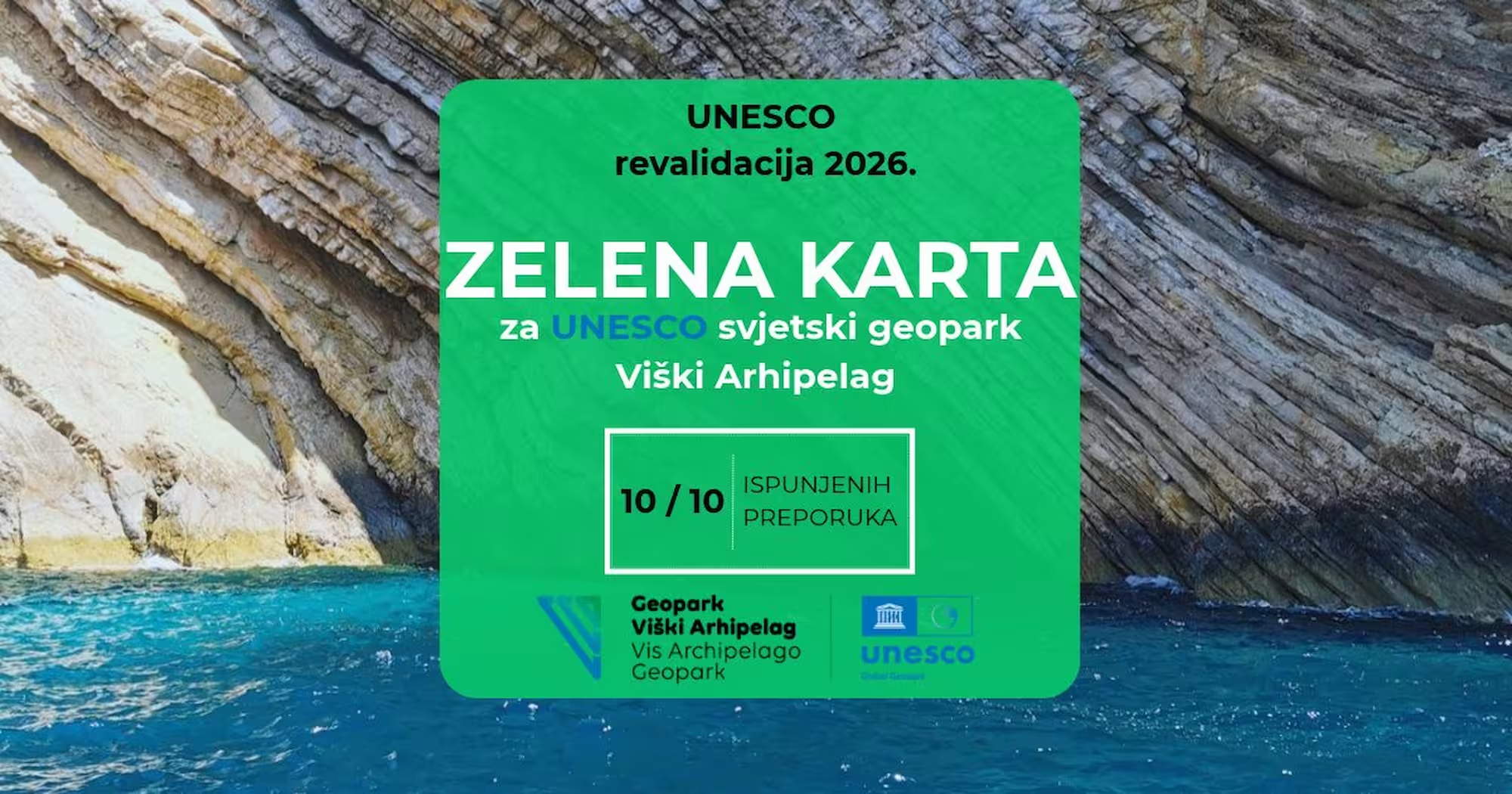
At the 11th session of the UNESCO Global Geoparks Council, held at UNESCO headquarters in Paris, the Vis Archipelago Geopark was awarded a green card, successfully completing its second revalidation and confirming the continuation of its status as a UNESCO Global Geopark. All ten recommendations from the previous revalidation, conducted in 2022, were assessed as successfully fulfilled.
This decision represents an important confirmation of the Geopark's continuous development and the results achieved over the past four years in the fields of protection and interpretation of geological, natural, and cultural heritage, scientific research, education, international cooperation, and the sustainable development of the Vis Archipelago.
The revalidation process included a review of documentation and a four-day field evaluation conducted in June 2026. International evaluators visited numerous sites and facilities within the Geopark and held discussions with representatives of local government, institutions, the scientific community, educational establishments, associations, local producers, and other partners.
In the final report, the Vis Archipelago Geopark was described as a mature and stable geopark, with special emphasis placed on the effort invested in fulfilling previous recommendations and its continuous development.
Ten recommendations – ten fulfilled
One of the most important results of this year's revalidation is the confirmation that the Geopark has successfully addressed all ten recommendations from the previous evaluation cycle.
The recommendations included strengthening the Geopark's visibility, developing interpretive and educational content, collaborating with scientific and educational institutions, involving local stakeholders, responsible water usage, developing geo-trails, and participating more actively in national and international geopark networks.
Over the past four years, the Geopark has developed new projects and content, expanded its network of partnerships, and implemented activities aimed at making the archipelago's geological and other heritage more accessible and understandable to residents and visitors.
A particularly important part of this work relates to connecting scientific knowledge with local needs, from education about groundwater and the karst system of the island of Vis to the interpretation of the traditional landscape, the development of geo-trails, and cooperation with local producers.
What did the international evaluators highlight in particular?
Excellent visibility and recognition of the Geopark
The evaluators rated the Geopark's visibility within the archipelago as excellent. They specifically highlighted clearly marked sites, the presence of the Geopark's visual identity, informative and interpretive content, and a well-developed network of partner organizations.
Progress in bringing complex geological topics closer to the general public was also positively evaluated, with the educational animated film Groundwater of the Vis Archipelagostanding out in particular. The film explains the unique features of the groundwater on the island of Vis and the importance of its responsible use in an understandable way.
Strong partnerships and support for the local economy
International evaluators described the Geopark's partnerships as strong and well-developed, highlighting cooperation with local and national institutions, educational and scientific establishments, the tourism sector, associations, and local entrepreneurs and producers.
During the revalidation period, the following was achieved: 16 new partnerships with local agricultural producers, further strengthening the Geopark's connection with the island's economy.
The report specifically recognizes the Geopark's contribution to sustainable development, not only through tourism but also by supporting local agricultural and food production, particularly viticulture and winemaking.
Education and scientific research as key pillars of operations
The evaluators highly praised the Geopark's educational activities, noting their significant scope relative to the size of the local community.
Collaboration with schools, universities, the Croatian Geological Survey, and other research institutions has enabled the development of numerous educational programs and scientific activities.
Key areas of research highlighted include salt tectonics and the Komiža salt diapir, the hydrogeological system of the island of Vis, and studies of marine ecosystems.
The new geopath was also positively evaluated Put poja, which connects natural heritage with the history of land use, viticulture, dry-stone construction, and traditional ways of life.
The Geopark as a link between Vis and Komiža
One of the most significant conclusions drawn by the evaluators concerns the Geopark's role in connecting the island community.
The report recognizes the Geopark as a shared framework for cooperation between Vis and Komiža, their institutions, residents, and local initiatives.
This role goes beyond individual projects and activities. The Geopark contributes to creating a unified approach to heritage conservation, education, and the social and economic development of the entire archipelago.
Active role in the international network of UNESCO Global Geoparks
The evaluators confirmed the active participation of the Vis Archipelago Geopark in the Croatian, European, and global networks of UNESCO Geoparks.
Participation in international conferences, the presentation of scientific and professional papers, formal partnerships with other geoparks, and joint European projects facilitate the exchange of experience and the development of new approaches to the protection, interpretation, and sustainable use of heritage.
The Geopark's contribution to joint initiatives by Croatian UNESCO Global Geoparks, as well as its collaboration with other UNESCO programs, was particularly highlighted.
Four new recommendations for further development
The green card confirms successful work in the previous period while simultaneously opening a new four-year development cycle.
International evaluators have provided four new recommendations that will serve as guidelines for the Geopark's future activities.
These relate to:
- More modern interpretation of geological heritage, particularly the Komiža salt diapir, through the development of 3D models and interactive educational content, as well as better information regarding coastal erosion processes.
- Connecting geology and marine ecosystems, with an emphasis on understanding the impact of geological features and processes on marine habitats and wildlife.
- Preservation of traditional architecture and dry-stone heritage, along with educating and involving younger generations in the preservation of traditional skills.
- Continuing education on the responsible use of natural resources, especially water and electricity, and raising awareness of local natural risks.
Some of these areas are already covered by the Geopark's new project activities. Among them is the international project GEOHERITAGE, which provides for the development of interactive geological 3D models and new content for the interpretation of marine and coastal geoheritage.
These new recommendations represent an opportunity to further connect scientific research, modern interpretation methods, and the needs of the local community.
Recognition of collective effort and encouragement for the future
The successful revalidation is the result of years of work, expertise, and cooperation from numerous individuals and organizations that have contributed to the development of the Vis Archipelago Geopark.
We would like to extend a special thank you to all current and former members of the Geopark team who directly designed and implemented projects, educational programs, research, and other activities, as well as to our expert associates, scientists, teachers, students, local producers, associations, partner institutions, founders, and the many individuals who have participated in its development through their work, knowledge, ideas, and support.
The confirmation from the international evaluators is particularly valuable because they highlighted in their final report that the documentation and results presented correspond to what they observed themselves during their field mission.
The Vis Archipelago Geopark continues to develop its role not only as an area of internationally recognized geological heritage but also as a space for knowledge, cooperation, and new opportunities for the local community.
The Green Card is a recognition of our work to date, as well as an incentive to continue our joint efforts in the preservation and sustainable development of the archipelago.
Thank you to everyone who is part of this story!


Posljednje novosti

Hrvatskih mučenika 17
21485 Komiža, Croatia
+385 91 271 30 23
geopark@geopark-vis.com
Fotografije: Ivo Pervan, Matko Petrić, Stjepan Mekinić
Design & development: P3R0